
Cast vs. minted gold bars: how they differ and which to choose
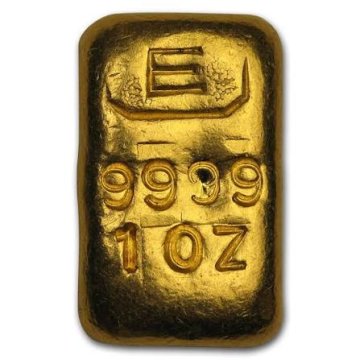
Browse through gold bars and you will come across two types that look completely different. One shines like a mirror, has sharp edges and a design, and sits sealed in a plastic card. The other resembles a small brick with a rough surface and rounded edges. The first is called a minted bar, the second a cast bar. Both contain equally fine gold, but they differ in how they are made, how they look, how they are protected and what they cost per gram. In this article we explain how both types are produced, how to tell them apart and why small weights such as the 1g Argor-Heraeus gold bar are practically always minted. Where the gold comes from before bars are made is covered in The journey of gold from mine to bar.
Cast vs. minted bars at a glance
| Cast bar | Minted bar | |
|---|---|---|
| Production | molten gold is poured into a mould and left to solidify | a blank is punched from rolled gold strip and struck in a press |
| Surface | matte to shiny, small irregularities and cooling marks | smooth, mirror-bright, sharp edges |
| Design | usually only details stamped with a punch (logo, weight, fineness, number) | detailed design, often on both sides |
| Typical weights | larger bars, typically from 50–100 g, 1 kg and large bank bars | from 1 g to 100 g, occasionally more |
| Packaging | often loose or in simple packaging with a certificate | sealed blister or card with a certificate |
| Price per gram | lower premium, simpler production | higher premium, especially for the smallest weights |
How a cast bar is made
The cast bar is the oldest and simplest form of gold. The refinery melts gold with a fineness of 999.9 and pours it into a mould of the right size. The metal gradually cools and solidifies, and this is exactly what creates the typical look: a slightly sunken centre, fine ripples and rounded edges. Once cooled, the bar is removed, cleaned and stamped with the maker’s logo, weight, fineness and usually a serial number.
Every cast bar is a little one-off – two pieces of the same weight never look exactly alike. Casting is also used for the large bars traded by banks and central banks, such as the standard London Good Delivery bar weighing around 400 troy ounces (about 12.4 kg). What this standard means is explained in What is LBMA and Good Delivery certification.
How a minted bar is made
A minted bar is produced much like a coin. The gold is first cast into a rod, which is rolled into a strip of precise thickness, and blanks of the required size are punched out of the strip. Each blank is weighed, and if the weight is off, it goes back into the melt. The blanks are annealed, polished and finally struck in a press between two dies. The design, lettering and sharp edges are all created in a single strike.
The finished bar is immediately sealed in a protective blister or a card with a certificate, so nobody touches it again. That is why minted bars have a flawless surface and a uniform appearance. Typical examples are PAMP Fortuna with the image of the goddess of fortune, or the standard Argor-Heraeus bars, whose background is described in The story of Argor-Heraeus.
Why small weights are minted
In theory, a 1 g or 2 g bar could be cast too. In practice it makes no sense, for several reasons:
- Exact weight. When casting a small piece, it is hard to hit the weight to a hundredth of a gram. With minting, the weight is checked at the blank stage, so every piece matches its stated value exactly.
- Series production. A press strikes thousands of identical pieces a day, while every cast bar needs its own mould, cooling time and hand finishing. For small pieces, the manual work would cost more than the extra metal.
- Security features. Holograms or microscopic details can only be placed on a minted surface. One example is the 5g Argor-Heraeus Kinebar gold bar with a kinegram directly on the bar.
- Size and appearance. A one-gram bar is roughly the size of a fingernail. A cast version would look crude and be hard to read, whereas minting allows clean, legible details even on a tiny surface.
The higher cost of producing a small minted bar is reflected in the price per gram. As a guide: on 24 September 2026, the 1g Argor-Heraeus gold bar cost $151.06 on goldu.cz, while the 20g Argor-Heraeus gold bar worked out at about $140 per gram. Why the price per gram differs – and why it does not always fall evenly as the weight rises – is explained in Premium on gold: why the price per gram differs.
How to tell cast and minted bars apart
Anyone can spot the difference in a few seconds:
- Edges: minted bars have sharp, straight edges; cast bars have rounded, slightly irregular ones.
- Surface: minted bars are smooth and shiny; cast bars show visible cooling marks and small irregularities.
- Details: on a minted bar they are part of the design; on a cast bar they are stamped in afterwards, often slightly crooked or at uneven depth.
- Packaging: minted bars usually come sealed in a blister or card with a certificate; cast bars are often loose with a separate certificate.
What the markings on a bar actually mean is explained in How to read fineness and markings on gold. Bear in mind, though, that a cast look says nothing about authenticity – and neither does the shiny surface of a minted bar.
Authenticity: where the minted bar has the edge
A minted bar in an intact blister is the easiest to verify. The serial number on the bar matches the number on the certificate, and packaging sealed by the maker shows that nobody has tampered with the bar since production. Some makers add further features: Argor-Heraeus uses the Kinebar hologram, PAMP the Veriscan technology, which lets you verify a specific piece by its surface. Which Kinebar size suits which purpose is covered in Which weight to choose for the Argor-Heraeus Kinebar.
A cast bar without packaging usually needs more effort to verify: measuring its dimensions and weight, using a precious-metal testing device or sending it to an assay office. That is why, for smaller investments, it is more practical to stick with minted bars and leave the packaging unopened. Answers to further questions on authenticity can be found in our FAQ on investment gold and silver.
Are cast and minted bars worth the same?
In terms of gold content, yes. Both types from reputable refineries have a fineness of 999.9, and the value of a bar depends mainly on the weight of fine metal and the current gold price. The difference lies in the premium you pay when buying and in how easily you can sell the bar. A minted bar in intact packaging is accepted by buyers quickly and without further testing. What to watch out for when selling is described in How to safely sell investment gold.
So the brand matters more than the production method. A bar from an LBMA-accredited refinery is easier to sell than one from an unknown maker. An overview of the makers in our range can be found on the page Investment gold and silver refineries.
Which type should you choose?
A minted bar is the right choice for most private investors. It lets you buy gradually in small weights, its authenticity is easy to verify and it sells well. It also makes a good gift. When a bar is the better choice and when a coin is, is explained in Gold bar or gold coin?
A cast bar makes sense mainly for larger amounts, when the lower premium per gram matters more than the convenience of a blister. This typically means weights of 100 g and above.
At GOLDU, all gold bars are minted and come in their original sealed blister or card with a certificate, from 1 g through the 1 oz Argor-Heraeus up to 100 g. We sell only new investment gold, never anything from buybacks. Whatever is offered in the e-shop is physically in stock and ships immediately.
Frequently asked questions
Is a cast bar of lower quality than a minted one?
No. From a reputable refinery, both types have the same fineness of 999.9. They differ in production, appearance and premium, not in the quality of the gold.
Why are there no cast 1 g bars?
Casting small pieces is imprecise in weight, and every piece requires manual work. Minting from rolled strip ensures exact weight, a uniform appearance and security features at a lower cost per piece.
Does a cast bar have a serial number?
Larger cast bars from reputable refineries usually do, stamped directly into the bar. With minted bars in a blister, the serial number on the bar matches the number on the certificate.
Will a cast bar be bought back at the same price as a minted one?
The buyback price depends on the weight, brand and condition of the bar. What matters most is whether it comes from a well-known refinery and whether it is undamaged; the production method plays a smaller role. GOLDU’s buyback terms are on the page Gold buyback.
Can I take a minted bar out of its blister?
You can, but we do not recommend it. An intact blister is the simplest proof of authenticity and saves time – and possibly testing – when you sell.
About the author
Adolf Baumann, analyst at Baumann Group a.s. (GOLDU), has been working with precious metals for over 30 years. He has seen euphoria, crashes and panic on the markets – and he still enjoys it. He explains in plain language what moves the price of gold and silver and how to handle them without unnecessary mistakes. His weakness? He refuses to wear a suit.


