
Britannia Coin Security Features: How They Work
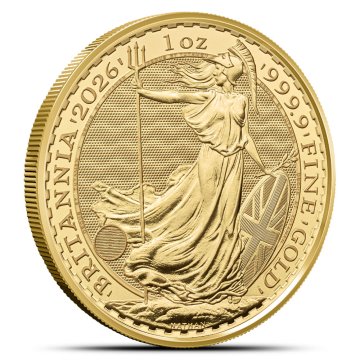
The Royal Mint has equipped the Britannia with a set of security features that it describes as the most advanced protection a widely available bullion coin has ever had. In this article we explain how each feature works and how you can check the authenticity of a Britannia yourself.
Surface animation
The most striking feature is a microscopically fine relief of waves behind the figure of Britannia, created with picosecond lasers. When you move the coin and tilt it towards the light, the waves appear to “come alive” and their pattern moves. This effect cannot be imitated with ordinary minting, because it requires sub-micron precision when the die is made.
Tincture lines
The Royal Mint revived a traditional heraldic technique on the coin: tinctures – a system of fine lines and dots used in black-and-white heraldry to represent the colours of a coat of arms. This pattern is extremely hard to reproduce faithfully in metal, so it serves as another layer of protection against counterfeiting.
“DECUS ET TUTAMEN” microtext
Around the figure of Britannia runs the Latin inscription DECUS ET TUTAMEN (loosely “an ornament and a safeguard”), engraved in microscopic lettering with specialised lasers. The legibility and precision of this text is another clue – on a fake, the microtext is often blurred, illegible or missing altogether.
Picosecond lasers: the technology behind the protection
The Royal Mint was among the first mints in the world to use advanced picosecond lasers for coin production – a technology otherwise used mainly in medicine and aviation. It allows work at sub-micron level and details with lines up to 200 times narrower than a human hair. It is precisely this precision that makes the combination of surface animation, tincture lines and microtext virtually impossible to copy with the dies typically used by counterfeiters.
How to check the security features yourself
Tilt and rotate the coin under a point light source (for example your phone’s torch) – the wave pattern should appear to “flow” and change with the viewing angle. Use a magnifying glass to check the sharpness of the microtext around Britannia. These features complement professional verification but do not replace it – at GOLDU we also verify authenticity with the Sigma Metalytics PMV PRO device, as described in the article How to verify the authenticity of investment gold.
The Britannia alongside other protected products
Similar, though technologically different, security features are used by other renowned mints and refineries – for example the hologram on Argor-Heraeus Kinebar bars or the Veriscan technology on PAMP Lady Fortuna bars. A comparison of the Britannia with another popular bullion coin can be found in the article Britannia vs. Australian Kangaroo.
Frequently asked questions
Do older Britannia coins have these security features?
Surface animation, tincture lines and microtext were introduced with the coin’s redesign in 2021. Older years do not have these specific features, but that does not make them any less genuine – it is simply a newer level of protection on the current issue.
Is a visual check enough instead of professional verification?
A visual check is a useful first step and quickly exposes crude fakes. For higher values, however, we always recommend professional verification with a device (such as the Sigma Metalytics PMV PRO) at a trusted dealer.
Do these security features also apply to the silver Britannia?
Yes. The Royal Mint introduced the same security features (surface animation, tincture lines, microtext) on both the gold and the silver Britannia.
About the author
Adolf Baumann, analyst at Baumann Group a.s. (GOLDU), has been working with precious metals for over 30 years. He has seen euphoria, crashes and panic on the markets – and he still enjoys it. He explains in plain language what moves the price of gold and silver and how to handle them without unnecessary mistakes. His weakness? He refuses to wear a suit.


